
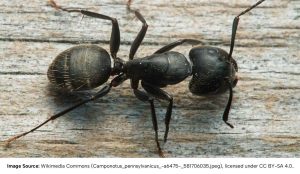
We are often asked questions such as “How do I stop carpenter ants?” and “What is the best way to get rid of carpenter ants?”
The short answer is to remove any rotten wood, prevent water damage, and stop ants before they crawl into a building such as your home with a long-lasting protective treatment around the exterior.
To really understand the answer to these questions and similar variations, it is important to know a bit of information about carpenter ants and what you can do to keep your home and other structures safe.
In Alberta, Saskatchewan, and Manitoba, carpenter ants normally start their nests in rotten wood. Carpenter ants can tunnel from rotten wood into undamaged wood and other adjacent materials, which can cause more damage to trees and structures when they expand their nests. One carpenter ant colony can have thousands of workers with different sizes (3.5 to 17 millimetres) moving between more than one satellite nest location, and satellite nests can be more than 200 to 300 metres from the nest holding their only queen. A carpenter ant colony and queen can live for more than twenty years, and worker ants can live for five years or more. It usually takes at least two or three years for a colony to mature enough to produce winged reproductive males and females (queens). Mating flights take place during the summer; most queens will not survive and can become food for other animals.
Carpenter ants eat bugs, honeydew from insects such as aphids, protein, fats, sugary materials, any other food they can find, and drink water, but they cannot digest wood. They will remove wood chunks, materials such as bits of insulation, bug parts, dead ants, and waste out from their nests into piles known as “frass”.
Termites are often blamed for carpenter ant activity, but termites are very unlikely to be found on the Prairies. Termites have bead-like parts that make up their straight antennae compared to the “elbowed” antennae of ants, do not have the pinched waist ants have, and all four wings are the same length on winged termites compared to two long wings and two short wings on winged ants.
To control carpenter ants, find their nests and treat them.
Carpenter Ant Infestations Start in Water-Damaged and Rotten Wood
Inspect, treat, and repair or remove rotten wood in common places such as:
- Wood mulch
- Landscape timbers/railroad ties
- Rotting wooden structures such as decks and sheds
- Dying and dead trees and stumps
- Firewood
- Structural water-damage to roofs, attics, windows, doors, walls, and from overflowing gutters and leaks
How To Stop Carpenter Ants With Exterior Perimeter Barrier Treatments
An exterior barrier treatment stops carpenter ants and other crawling bugs from getting in. Treatment is applied on the outside of a structure as a band around the foundation to create a protective barrier. This barrier is repellent and harmful to ants, lasts a long time, but may need to be reapplied every year and more than once per year. Any potential bridge points such as plants, grass, vines, and shrubs should be trimmed back to prevent ants from bypassing the barrier.
Pro tip: Timing matters. An early-season perimeter treatment service protects structures from ants returning to cause damage. Have treatment done early when there is a low risk of freezing temperatures and follow the recommendations of your pest management professional.
Carpenter Ant Signs
- Large black or red-and-black ants indoors, especially in late winter and early spring
- Piles of sawdust, tiny bits of insulation, dead ants, and pieces of bugs (frass)
- Clicking or rustling sounds inside wood
- Many winged ants (swarmers) inside in spring or early summer
If you see any of the above, an interior treatment can control ants indoors. A protective barrier treatment outside will help stop ants from becoming an indoor problem.
Do-It-Yourself (DIY) Carpenter Ant Control
- Maintenance and repairs: Prevent water damage, fix leaks, improve water drainage outdoors, clean and repair gutters and downspouts, repair structural damage, remove water-damaged wood, repair attic and structural ventilation issues, maintain and water-proof attached wooden structures such as decks and porches, move or remove or treat wood mulch, clear or prune vegetation away from siding, and remove or store firewood off the ground and away from the structure. If trees are dying and have carpenter ants, contact an arborist (tree specialist).
- What to do and mistakes to avoid: Always read the label before using any pesticide. Use a domestic long-lasting spray (Poulin’s Super Strength II) when the weather is warm and reapply after six weeks, as needed. Treat all the way around a structure and do not miss spots because carpenter ants travel further than may be expected. For ant activity indoors, spray and/or use bait (Green Way Ant Bait Gel). Bait can take weeks, works best if paired with an exterior treatment, needs other food sources secured, and should be placed close to nests and where ants are going for food and water. Please be advised that the nest with the queen in it may not be easy to find or treatable, and exterior treatments may need to be done for years.
Checklist for Property Managers & Maintenance Teams
- ☐ Schedule a spring perimeter treatment on your maintenance calendar
- ☐ Add a follow-up date for late summer/early fall
- ☐ Inspect for and repair any leaks and ventilation problems, this can take the form of ice-damming in winter
- ☐ Remove any water-damaged materials
- ☐ Inspect and maintain drainage systems such as gutters and downspouts
- ☐ Seal gaps on the exterior (plumbing, cable, HVAC, etc.)
- ☐ Maintain a 30 to 60 centimetre vegetation-free zone around buildings
- ☐ Remove or limit wood in the form of mulch, woodpiles, stumps, and landscape ties near buildings
Choose Poulin’s Pest Control to Protect Your Property From Carpenter Ants
Poulin’s Pest Control offers treatment programs designed to stop carpenter ants and protect your property, indoors and outdoors.
Don’t wait for carpenter ants to cause costly repairs. Book your exterior perimeter treatment with Poulin’s Pest Control today and protect your property all season long.